
By Victória Brotto
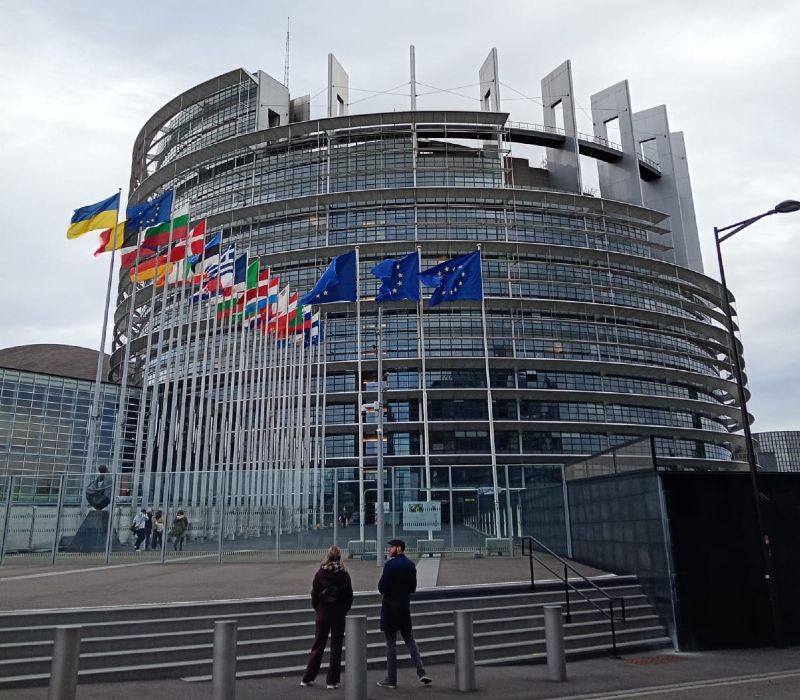
from Strasbourg, France (European Union’s capital).
Read also in Portuguese
Since October 17, France has been gripped by widespread protests. What began as demonstrations and school blockades has now evolved into a nationwide movement calling for better living conditions, including improved conditions for students. With Emmanuel Macron’s government in “free fall”, as the French put it, lacking parliamentary support and facing widespread public disapproval, with many seeing it as an architect of chaos, the government has once again, like its predecessors, opted for a response that is far more police-oriented than socially driven.
Various sociological studies have highlighted the increasingly repressive tendencies of European states since the 1980s. The welfare state, conceived in the post-war period to protect citizens against events that could undermine their social and economic stability (unemployment, ageing, the birth of children, illness), has now, under governments influenced by neoliberal policies, become a police state. In this new model, access to social rights increasingly depends on individual merit rather than on belonging to a nation. Individuals, particularly the poor and migrants, are subjected to constant state surveillance and control.
This growing state control, combined with Europe’s deepening social, fiscal and economic crises, has paved the way for protests. In France, as well as in Germany, Italy and the United Kingdom, populist movements are capitalising on the chaos and on governments’ inability to engage in dialogue. Rather than proposing concrete solutions and establishing effective channels of communication, Emmanuel Macron chose to announce that he himself was outraged by the protests, declare that Mr. Lecornu, the French prime minister, would take care of everything and, the following day, travel to Qatar. And actually, practically speaking, the French government cannot do much to improve the purchasing power of its citizen, regarding the debt and fiscal crisis of the French state.
While chaos provides fertile ground for the growth of extremism in all its forms, it is the far right in particular that is exploiting the situation and the incompetence of governments, whose responses are increasingly police-oriented, to spread a dangerous, if not extremely dangerous, message: foreigners are to blame for the chaos and the crisis, whether they are “migrants” or members of the international economic elite, of which current governments are supposedly nothing more than mere cronies.
With no solid ground to stand on and losing control in the face of the chaos generated by the ongoing war on the continent, the wave of disinformation spreading across social media and the increasingly precarious European way of life, a considerable proportion of citizens in different EU countries appear to be giving in — or rather, embracing — the rhetoric and political agenda of the far right.
In France and Germany, far-right parties have secured a significant share of parliamentary seats. Marine Le Pen is gaining ground in opinion polls ahead of next year’s French presidential election, while Jordan Bardella, national president of the far-right party Rassemblement National appears to be winning the support of a population searching for a young but hard-line figure to fight against migrants, the international elite, the poor who supposedly abuse state welfare, the European Union, which allegedly undermines national economic interests, ungrateful and violent young people… In other words, against everyone and everything.
“It is not the French who vandalise public property,” Bardella said, referring to some of the protesters. “ They are immigrants who do not share the values of our Republic.” Far-right movements are gaining strength, including neo-fascist groups, such as the movement allegedly behind the murder of a young black man in the French city of Trappes a few weeks ago. In a rare moment of clarity since the beginning of the protests, Mr. Sébastien Lecornu stated that the murder was the result of the racist rhetoric disseminated by the far-right wing.
SEARCHING FOR MODELS… AND STRATEGIC PARTNERS
With the presidential elections ahead, European governments, political parties, citizens and media organisations are searching, with a certain degree of desperation, for examples of movements that have managed to prevent the worst-case scenario: the far right coming to power in their respective countries, in a critical moment of economic and social crisis. Brazil is found to be an example as well as a strategic partner. The political and economic power of Europe has been in decline since the 2nd World War, and the EU’s economic performance raises serious concerns, even though the bloc is still competitive. Apart from economic matters, Europe is almost completely dependent on American’s army force, in the NATO setting, it is still very dependent on some Chinese and US technologies (such as batteries and bank security technologies) and begins to face serious climate-change problems, including difficulties accessing water and intense heatwaves. In that scenario, Brazil appears to be a good strategic partner as the country possesses significant reserves of minerals used in weapons manufacturing and appears to have found a way to defeat the far right at the ballot box, at least in presidential elections.
As a result, the European narrative about this South American country of 214.2 million inhabitants is gradually beginning to change. Beyond the traditional frameworks of thought inherited from the colonial era, new ways of approaching and categorising Brazil are emerging. Until now, Brazil has largely been perceived as the land of pleasure, fun and poverty (eg : the triad “beaches-football-favelas”). “Brazil shows that the worst is not always the most likely outcome,” said Fabien Roussel, the French Communist Party’s candidate, after Lula’s victory. In an article featured prominently on its website, Le Monde highlighted the Partido dos Trabalhadores (PT) strategy to win the elections: focusing on those who did not vote rather than trying to convince Bolsonaro voters.
Spain’s Prime Minister, Pedro Sánchez, wrote on social media: “The global progressive resurgence has just begun.” The United Kingdom’s Foreign Secretary, Ed Miliband, described to the Guardian Lula’s victory as “a historic victory for the global progressive movement” and said his government looked forward to continuing to work with Brazil based on “shared values of democracy, social justice and climate action”. European Commission President Ursula von der Leyen declared: “Democracy and multilateralism have prevailed in Brazil.”
On the social media platform X, the French president Emmanuel Macron expressed his interest in strengthening the France-Brazil partnership in the face of a future that appears increasingly difficult for Europe. “France and Brazil have much to build together. In the face of the major challenges of our time, let us strengthen our strategic partnership and keep the friendship between our two countries alive, in the service of a fairer world,” Macron wrote.
MIGRATION ISSUES
Migration is also at the core of the political discussions in Europe as governments struggle to manage the migration phenomenon ethically in an era of climate change and the rise of poverty. Since the last decades, EU is managing non EU-migration by high strict immigration policies and by the externalisation of migration control to third countries, such as Lebanon, Turkey and Morocco. Also, the far-right wing in European countries, as well as in the US, blames foreigners for urban violence, high rates of unemployment and rising poverty rates. The French far-right wing candidate Le Pen said that immigrants have destabilised French society, particularly due to an unemployment rate among immigrants in France that is ‘twice as high’.”
Little known to Europeans, Brazil’s migration policy is hardly presented as a model. It was indirectly, however, that Brazil reignited the debate on migration. The US government’s decision to welcome Flávio Bolsonaro, a Brazilian extremist who had fled the country, was criticised by the European press in general, particularly in light of the arbitrary detentions of undocumented migrants by US immigration enforcement authorities.
The unprecedented nature of Lula’s political comeback has also been mentioned as a factor behind the defeat of the Liberal Party (PL) candidate. Some newspapers referred to Lula as the “phoenix of South America”. Furthermore, Europeans tend to categorise South America, and Brazil in particular, as a land of charismatic leaders. According to the German sociologist Max Weber, charismatic leaders derive their authority from charisma, which grows stronger as they occupy increasingly prominent positions. Whether the far right’s defeat in Brazil can be attributed to Lula’s charismatic power is not really the central question. What matters, rather, is how Brazil will strengthen its place in the global arena, in a moment when the country is found to be an important strategic partner for a continent in decline but still with international relevance.
Developing a better political system and more effective economic management, as well as implementing fairer migration policies, are all part of the challenge if Brazil truly wishes to escape its perennial predicament as an “eternal developing country”. Growing on its own terms and for its own benefit appears to be the objective of Luís Inácio Lula da Silva’s government. The question now is how much of this growth can actually be achieved when confronted with the hard test of reality.
_____________
Victória Brotto is a journalist and sociologist based in Strasbourg. Graduated from Sciences Po Strasbourg, Brotto’s research focuses on international migration and public policy.
